
Placement formats
Buy guest posts.
Commission a new article when your page needs context that an existing story can’t provide. Start with a question the publisher’s readers already have.
Choose the angle
Give the editor a working headline and a one-sentence reader takeaway. An article about how to size a commercial oven can naturally reference your sizing chart. A broad article about kitchen equipment gives the editor less reason to cite it.
Read the publication
Open two recent articles in the proposed section. Look at their subject matter, named authors and how they cite outside resources. Ask who writes the draft, who can request changes and whether you can review the text before publication.
Set the terms
Ask for an itemized quote covering writing, editing and publication. Confirm the byline, disclosure, link attribute, review rounds and what happens if the editor declines the draft.
For a paid post, confirm how the publisher identifies sponsorship. Google recommends rel="sponsored" for paid links.
Find publications covering your topic in the business, technology or lifestyle directory. For a business article, compare the terms for AZ Big Media and Business Matters.
Decide what you want the reader to take away
A guest post earns its space by answering a question the publication’s readers already ask. Start with a reader, a decision and the evidence needed to make it. A piece for warehouse managers about choosing a pallet size needs different examples from an article for shop owners about packaging small orders. The target URL can stay the same only if it genuinely helps both readers.
Try the pitch on someone who has never heard of your company. Can they explain what they would learn after reading the proposed article? If their answer is just the product name, narrow the angle. A comparison of three packaging tests gives the writer a concrete task. A general introduction to a brand gives the editor little information about where a citation belongs.
Give the editor a source pack with the proposed headline, a short outline and the one or two facts that matter most. Add the primary source for each fact and identify which photographs or charts you have permission to publish. If a third party supplied the data, explain how its name and work should be credited. An editor can assess a well-documented claim before anyone spends time writing the full draft.
What the article offer covers
Read the publisher’s offer before deciding how much copy to commission. The AZ Big Media article listing records $80 USD, a range of 500 to 2,500 words, up to two URLs and an estimated seven days. The Business Matters article listing records $145 USD, the same word range, up to two URLs and an estimated five days. Both require confirmation of the link treatment. These examples show what a listing lets you compare before requesting current terms.
A maximum number of links is an editorial limit. It gives you room to propose references where the argument needs them. If your article uses one data source and one reader resource, name both in the brief. Ask whether citations to independent sources count toward the publisher’s URL limit and whether a byline link counts separately. Check the answer against the quote before a writer starts adding references.
Ask which parts of the job are included in the price: topic approval, drafting, editing, illustration, author biography, publication and a live URL. Agree on who handles factual corrections and how many revision rounds are included. A buyer supplying a finished, approved draft may need a different scope from a team commissioning interviews, writing and legal review.
From a proposed headline to the live URL
Send the exact offer ID with your proposed topic. Include a short description of the outlet’s reader, the draft headline and the page you would like to reference. If timing matters, state the publication deadline and any date before which the information must remain private. Ask when the turnaround estimate starts. It may depend on acceptance of the topic, receipt of a usable draft or approval of the final quote.
Once the scope is agreed, give the writer source links, preferred terminology and one person who can approve factual details. Ask to review the paragraph containing your citation together with the headline, byline and disclosure. The surrounding text matters because a link can point to the right URL and still promise readers something the destination does not deliver.
At publication, record the article URL and the date it went live. Check the headline, author credit, images and target link on both desktop and mobile. Follow the link to make sure it opens the intended resource. If a byline or disclosure changed between approval and publication, send the published paragraph and the approved text to placement support with the offer ID.
How link attributes apply to guest posts
An editor’s ordinary citation can be an HTML link with an href and no relationship attribute. Buyers often call this dofollow. For compensation or sponsorship, Google recommends rel="sponsored" and accepts rel="nofollow". A visible sponsorship label tells readers about the relationship. The HTML attribute supplies information to search engines. Confirm both treatments directly for the article you plan to commission.
Describe the destination accurately in the anchor text. For a guide to checking fabric abrasion, “fabric abrasion test results” tells readers what they will find. The name of the entire product range may be misleading if the destination documents only one fabric. Use the link attribute guide when reviewing sample markup.
An article can be publicly readable while carrying a noindex directive. Ask about page indexability if it matters to your brief. An indexable page can still take time to be discovered, and an editor cannot promise a particular search position. Agree on deliverables that can be checked, such as the live URL, byline, disclosure and approved destination.
A worked guest-post brief
Imagine an education publisher considering a piece on how to compare entry-level design courses. The reader is choosing between a short course and a longer qualification. A training provider has a dated assessment rubric showing the work participants must submit. A useful pitch would describe how assessment differs, explain what a passing submission includes and cite the rubric in the paragraph about assessment.
The proposed citation might read “the assessment rubric lists a portfolio review and a practical assignment.” The reader can follow the rubric to see the criteria. Send the editor its edition date and identify any criteria that changed for the next intake. In this example, a link to a general admissions homepage would leave the reader searching for the evidence.
Use the education category to consider relevant outlets. Open the offer most suited to the intended audience, record the price or quote-only status and list any topic restrictions. Ask the publisher to confirm the editorial fit and disclosure before expanding this outline into a commissioned article.
Choose a publication section before writing the draft
Look at where a similar article would actually sit on the site. Read a recent piece from the relevant section and write down the level of knowledge it assumes. Do the examples address a person making a buying decision, doing a specialist job or looking for a general introduction? Check the dates and bylines. A business site can publish market news, opinion and practical guides for different readers. Knowing which section you are pitching gives the editor a meaningful starting point.
Consider who can speak with first-hand knowledge. A company founder might explain why a decision was made. A technician who carried out the work can explain the test conditions, limitations and the result. Choose the voice that fits the specific question. If the publication requires an author biography or website, supply an approved version with a real name and accurate role. Ask whether a biography link counts toward the offer’s URL allowance.
Review the proposed source page itself. It should support the exact sentence that introduces it. A sentence about how a material performed in a lab test can point to the test method and findings. A commercial product page containing neither is a weak source for that sentence, even if it sells the material. Move the citation to where the page helps the reader, replace the source or change the claim before commissioning the piece.
Work through a price comparison
Suppose your brief fits either AZ Big Media or Business Matters. Their Article records both specify 500 to 2,500 words and up to two URLs. AZ Big Media lists $80.00 USD and seven days. Business Matters lists $145.00 USD and five days. Both records leave the link treatment open for confirmation. The difference between the two listed prices buys no certainty about an attribute, inclusion in a particular section or acceptance of the draft.
Write down which difference changes your decision. A team with a flexible publication date might prioritise the section its buyers read. A team needing a story before a trade show would ask whether either publisher can confirm a specific deadline after approval. If the finished draft is 2,700 words, neither recorded word range covers it as submitted. Ask the writer to identify what can be cut or obtain an explicit exception before paying for the longer version.
An article that includes a licensed photo raises another question. A licence for the company’s own website may give a third-party publication different rights. Supply the image credit and permitted uses, or prepare a text-only version. Ask whether the same illustration can stay online in the archived post. Resolve permission and any additional fee in the quote while there is still time to choose an alternative.
Where article revisions go wrong
Separate factual review from editorial preferences. If a quoted figure changes during editing, check the underlying source and send the corrected sentence with its evidence. If only the headline changes, ask whether the new wording still describes what readers will find. Keeping one approved draft and one person responsible for signing it off avoids sending the editor contradictory changes.
Check for links introduced or lost during formatting. A citation inside a pasted document may display as plain text on the published page. A biography may use a different destination from the one in the main article. Record the specific written allowance and test each intended link on the public page once it is live. If the agreement calls for one link, finding a second unrevealing badge or navigation link does not establish that the requested citation is present.
Plan how to tell whether the article helped a reader. For a tutorial, that might be visits to the referenced checklist, completion of a calculation or requests about the method described. Choose a relevant observation your team can actually make and note the publication date. Small numbers and events occurring at the same time make attribution uncertain. The clearest delivery evidence remains the live article, its content and the terms you approved.
Questions about buying a guest post
Can I supply my own article or writer?
Tell the desk how much work is complete. Provide a short outline first if the publisher has not approved the angle. For a finished draft, supply the word count, source links, byline, image credits and requested destination. Ask whether the editor accepts external drafts and who is responsible for rewriting material that falls outside the publication’s guidelines.
Which topics are excluded?
Exclusions belong to individual offers. The AZ Big Media and Business Matters listings above both name gambling, CBD, adult, crypto and dating. A general business or lifestyle category is insufficient evidence that an editor accepts a restricted topic. Share the target URL and the proposed article subject together so both can be reviewed.
What if the editor changes or rejects the draft?
Agree on the response before approving the quote. Ask whether the scope includes revisions, a new angle or a different publisher, and what happens to writing fees if publication is declined. A substitute outlet requires its own terms and your approval. Keep the quoted publisher, offer ID and agreed changes together.
What should a finished order include?
Ask for the live article URL and compare it with the approved draft and quote. Keep a dated copy of the citation, its link treatment and the visible disclosure. For changes after publication, use the receipt from your enquiry. The buyer FAQ explains common questions, and how the directory works explains what the placement desk records.
Placement desk
What are you
working on?
Tell us about the page you want people to find and the readers you want to reach.
Get a quote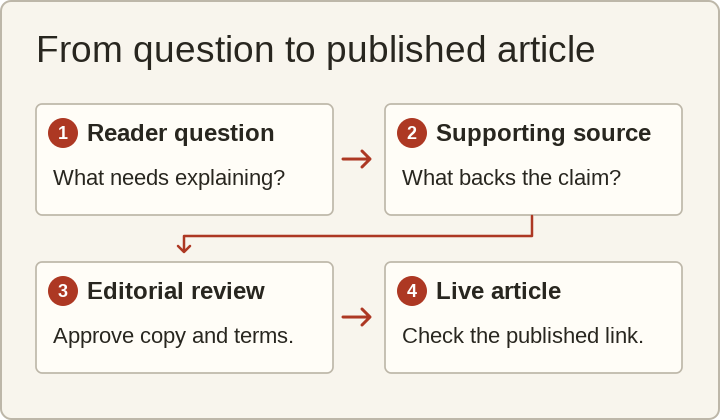
Updated