
Placement formats
Press release placements.
For a product launch, funding announcement or company milestone, compare outlets that list a press release format. The directory includes ten such offers.
Choose the announcement
A press release works best when the news can be stated in one sentence. Prepare the announcement date, a named company contact, a source for each factual claim and any embargo. Confirm whether the outlet edits the headline or adds its own disclosure.
Compare listed terms
Open the individual listing to see its recorded rate and limits. The Big News Network press release listing, for example, records $5.00 USD. Verify final pricing, eligibility and link terms for your announcement before ordering.
Review the Big News Network listingRequest the exact placement
Filter the directory to press releases, select an offer and open the enquiry chat. The team receives your selected publisher and offer ID along with your brief.
Browse all press release offersWhat you receive from a named release placement
A release gives a reader the facts of an announcement in the announcing organisation’s own words. A named placement specifies where the release can appear. If your buying decision depends on a particular news outlet, publication date or link, put that requirement in the enquiry and ask for it to be addressed in the quote.
A wire distribution package is a different purchase. It may send material to multiple destinations, some of which decide independently whether to display it. A journalist can also report an announcement in their own words. Listing a single press release here makes no promise about wire distribution, additional pickups, interviews or independent reporting. Decide which of those outcomes actually forms part of the order before comparing prices.
Choose a destination that will still be useful when someone reads the announcement later. A public newsroom entry with the launch date, product name and technical documentation often serves the reader better than a general homepage. Check that a mobile visitor can open the destination and find the promised information without signing in. If the release points to a time-limited registration page, decide where readers should land after registration closes.
Price, length and the publication window
The Big News Network offer lists $5.00 USD, 500 to 2,500 words, up to two URLs and an estimated six days. The IPS News offer lists $10.00 USD, 500 to 1,000 words, one URL and an estimated five days. These are separate offers. Both leave the link treatment to be confirmed and list gambling, CBD, adult, crypto and dating among their exclusions.
For a team with a 700-word release and one source link, either set of recorded length and URL limits could work. At 1,200 words the IPS News limit becomes a concrete editing decision. Present the short version for review or enquire about a different offer. Adding a second link to the short version is a separate change, even if the copy still meets the word limit. Confirm the quote against the version you actually plan to submit.
Ask whether an estimate starts when you send the enquiry, when the publisher accepts the copy, or after the approved order is ready to run. Give the requested date, time and time zone. Identify any earliest permitted publication time separately from your preferred deadline. A publisher able to consider a release within five days may still be unable to hold it for a specific minute on launch morning.
Prepare a release an editor can check
Write the first paragraph as a short news report. Name the organisation, identify what changed, give the date and say who can use the new information. Distinguish an announcement about a future service from a service that is already available. Readers in a different region need to know where a product, programme or event is actually accessible.
For each important claim, give the reviewer something they can inspect. For a survey, identify the field dates, population, number of responses and question wording. For an expansion, provide the locations and opening date. For an award, link to the organisation that announced the result. A superlative such as “first” needs evidence for the relevant market and time period. Where that evidence is missing, a precise statement about what changed reads better.
Secure permission for attributed quotations, partner names and supporting images before submission. Keep a list of approved spellings and job titles. Give the desk one editorial contact who can answer factual questions and distinguish that person’s private contact details from the public press contact you want in the release. If a partner has approval rights over the announcement, schedule its review before asking for publication.
Follow the release from brief to live URL
Select the individual offer and open the enquiry there so the desk receives the publication, format and offer ID. Supply the proposed headline, release date, target URL, word length and requested publication window. If your team has a release ready, say which version is approved and which details remain confidential. The enquiry details explain what goes into the initial conversation.
Compare the written quote with the submitted brief. Check the named destination, listed amount, final total, accepted copy, link allowance, disclosures, estimated timing and any agreed changes or aftercare. Ask who may edit the title and who must approve an edit that changes the meaning of a quote or a finding. Settle writing, invoice and cancellation questions before authorising work.
After publication, open the public page from a new browser session. Check the dateline, title, named people, quotations and source URL against the approved version. If the announcement appears on a brand’s news subdomain, record that exact page. A logo, screenshot or list of distribution destinations alone cannot tell you whether a particular story is publicly accessible. Save the article URL, the agreed scope and the date of the check together.
Link treatment and disclosure on a release
A publisher may identify a commercial relationship within the release, in a label next to the article, in the link attributes or in more than one place. These serve different readers. A visible label gives people context. An HTML attribute such as sponsored or nofollow gives search engines information about the link. Ask what will appear both on the page and in the link markup.
“Dofollow” is customary shorthand for an ordinary link without a qualifying attribute such as nofollow or sponsored. Google recommends sponsored for paid links and also accepts nofollow. A release marked nofollow can still take a person directly to the announcement or evidence. A publication, link attribute or search engine crawl cannot guarantee indexing, traffic or rankings. See the link attribute guide for examples.
Worked example for a timed announcement
Suppose an education business is publishing a report about course completion. Its research page will go live at 9 am Eastern on a Tuesday. The team has a 740-word release, an approved quotation from the research lead and one link to a page containing the data and methodology. It wants a named release placement readers can visit after the findings are public.
The team shortlists the one-URL offer and gives the desk the agreed public time and an earliest release time. It asks whether the editor can review the material under embargo and whether the reported estimate fits its schedule. If the terms do not support an embargo, it can wait until the report is public before sending the release. A written confirmation is more useful here than a low headline rate.
If the intended piece is a tutorial for teachers on applying those findings in class, the audience needs examples and explanation. Compare the education publishers and guest post format for that separate article. A retailer introducing access to the same data for merchants can compare e-commerce publishers for a similarly focused follow-up.
Questions about release placement
Can I buy a guaranteed ranking or a headline on the homepage?
An offer for a named release identifies a publication format. A homepage slot, newsletter or social promotion needs its own written terms. Ask for the actual destination, display period and deliverable if any of those features matters to you. Search rankings and editorial coverage remain outside the scope of a named placement.
What if a link disappears or the outlet edits the release?
Keep the original URL, version and confirmation. Record which sentence, detail or link changed and when you observed it. Send the evidence through placement support so the desk can check the agreed aftercare, any correction option and applicable payment or refund terms. Establish those terms before ordering, particularly for an event whose news value expires on a specific date.
What if the announcement is unsuitable for the selected outlet?
An editor may decline a topic, an unsupported claim, a destination or a format. Choose a different eligible offer only after reviewing its own price and conditions. Browse the press release category to see alternatives. The placement checklist and buyer FAQ can help a communications team agree on the required information before enquiring.
Placement desk
What are you
working on?
Tell us about the page you want people to find and the readers you want to reach.
Get a quote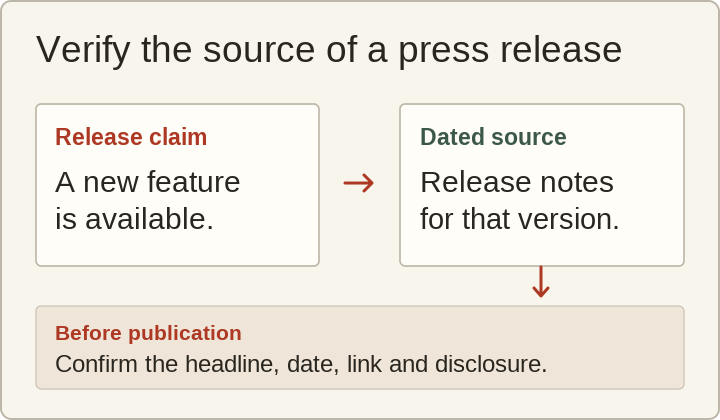
Updated